Zero-Second Thinking Summary: The McKinsey Japan '1-Minute A4 Memo' Method to Eliminate Overthinking
An English breakdown of Yuji Akaba's untranslated Japanese bestseller 'Zero-Second Thinking' (ゼロ秒思考). Learn how writing 10 one-minute pages of raw thoughts on blank paper every day clears mental RAM faster than any digital second-brain app.
Disclosure: This page contains affiliate links. As an Amazon Associate, BookInsight earns from qualifying purchases.
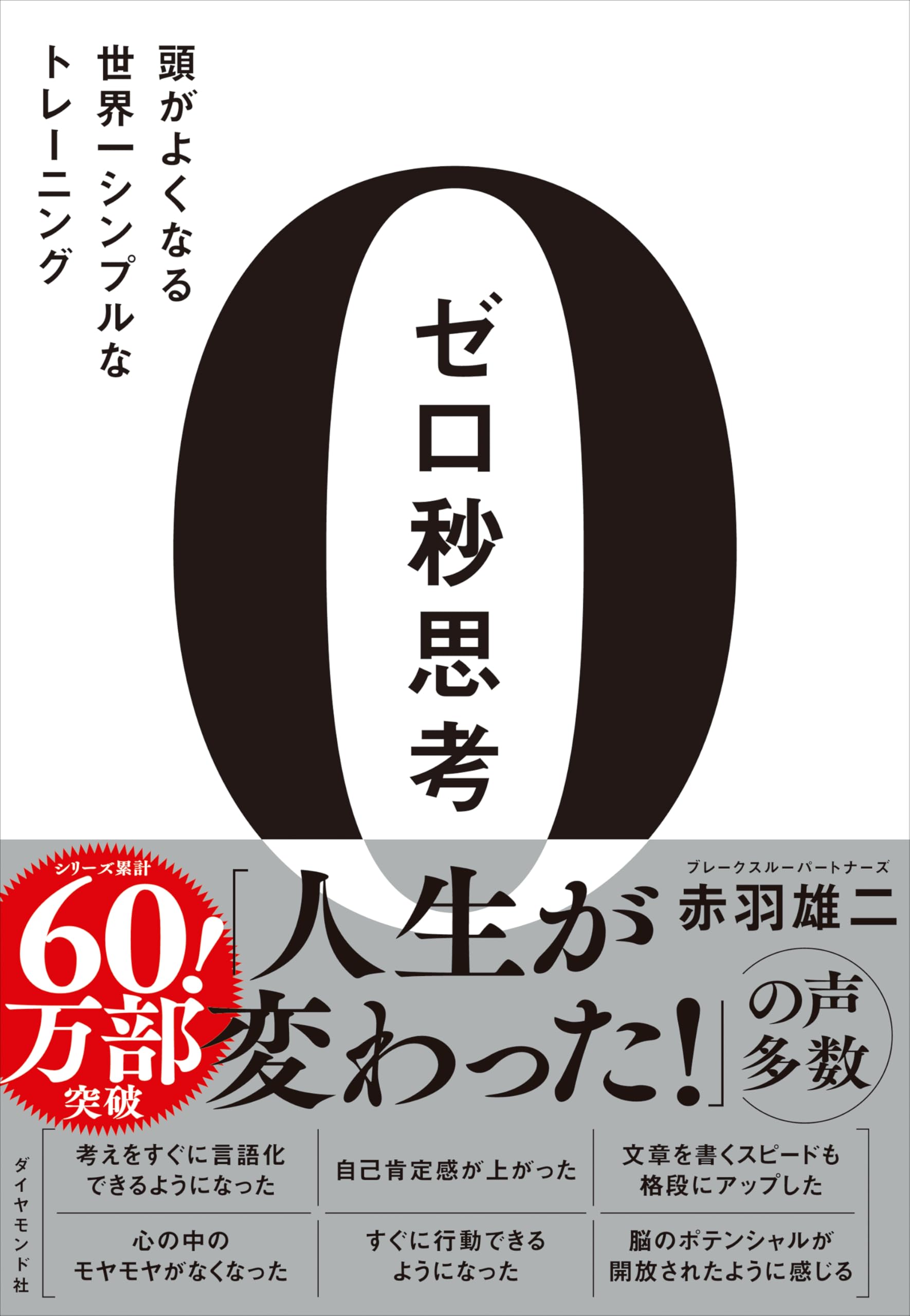
Zero-Second Thinking (ゼロ秒思考)
Original Japanese Title: ゼロ秒思考 頭がよくなる世界一シンプルなトレーニング
Author:Yuji Akaba (赤羽雄二)
Publisher:Diamond Inc. (2013)
Length:256 pages
3-Minute Core Breakdown: Zero-Second Thinking (ゼロ秒思考)
“Everyone is born with a sharp mind. Most people simply have never trained the muscle of instant verbalization.”
3 Core Takeaways
- 1Stop ruminating in your head: externalize raw thoughts onto a landscape A4 (or US Letter) sheet in strictly 60 seconds
- 2Write 10 pages per day (10 minutes total) to train instant verbalization and decision speed
- 3Ditch complex digital note apps when your brain is stalled; physical pen-on-paper bypasses self-editing
Who Should Read This
- ✓Knowledge workers trapped in 'analysis paralysis' or over-engineering their Notion/Obsidian setups
- ✓Engineers and managers who freeze when asked for an immediate opinion in high-stakes meetings
- ✓Global readers looking for practical Japanese management and consulting frameworks not yet translated into English
Why Hours of “Deep Thinking” Leave You More Confused Than When You Started
You sit at your desk for two hours staring at a strategy doc or architecture problem, yet you end up with zero decisions.
What feels like “careful deliberation” is almost always your brain spinning in the same three unverbalized loops.
In Japan, one of the most widely practiced antidotes to this mental gridlock is Zero-Second Thinking (Zero-Byo Shiko), a bestseller by Yuji Akaba, a former 14-year McKinsey & Company partner. While Western productivity culture has gravitated toward elaborate digital “Second Brain” systems, Akaba’s method strips thinking down to a stopwatch, a fast-flowing pen, and 10 sheets of scrap paper a day.
“Going around in circles inside your head is not thinking—it is merely worrying. Thinking only begins the moment you force vague feelings into concrete words on paper.”
Mental Spinning vs. Zero-Second Memo Writing
- ✕Ruminates on the same anxiety or trade-off for hours without writing it down
- ✕Polishes formatting in digital note apps instead of confronting the core issue
- ✕Freezes when asked 'What do you think?' in live meetings
- ✓Dumps 4 to 6 bullet lines onto a landscape sheet in strictly 60 seconds
- ✓Separates emotional fog from structural bottlenecks in 10 minutes a day
- ✓Builds the reflex to structure and articulate conclusions on the spot
The 4 Strict Rules of the 1-Minute A4 Memo
Akaba’s framework works precisely because its physical constraints leave zero room for perfectionism or self-censorship.
1. Place Unlined A4 (or US Letter) Paper Horizontally
Use plain printer paper or scrap paper (backside of old printouts) in landscape orientation.
Avoid lined notebooks or fancy journals—pre-printed lines and bound pages subconsciously make you write neatly instead of dumping raw thoughts.
2. Write a Specific Question as the Title, Plus Today’s Date
At the top left, write a concrete question or friction point on your mind (e.g., “Why is the Q3 API migration stalling?” or “Why am I annoyed by yesterday’s 1-on-1?”), and put the date at the top right.
3. Write 4 to 6 Lines (15–25 Words per Line)
Write 4 to 6 dashes down the page.
Do not use single-word fragments (which are too vague to expose faulty logic), and do not write full paragraphs. Write complete, blunt sentences: “The root issue isn’t the database schema; it’s that two teams haven’t agreed on who owns the rollback script.”
4. Enforce a Hard 60-Second Time Limit per Page
Set a timer for 1 minute.
When you have 5 minutes, your inner critic wakes up and tries to sound smart. When you only have 60 seconds, your brain is forced to spit out the unfiltered truth.
Why 10 Pages a Day Trains “Zero-Second” Clarity
The goal is not to build an archive of notes to search later.
Writing 10 separate sheets a day (10 minutes total) acts like garbage collection for your working memory. When a complex issue surfaces, Akaba recommends deep-drilling: taking the 4–6 bullet points from your first memo and turning each bullet into the title of a new 1-minute page.
Within 5 minutes, you have mapped out an issue to a depth that normally takes a 60-minute meeting.
Real-World Pitfalls & How to Overcome Them (3 Hurdles)
The rule of writing 10 one-minute A4 pages every day looks simple, but the simplicity is deceptive—many people drop the habit within the first few weeks.
Here are three practical bottlenecks that commonly break the habit, and modifications that make it sustainable.
1. Staring at a Blank Sheet Trying to Invent a “Title”
The book says each page takes 60 seconds, so 10 pages should take 10 minutes.
In practice, it is easy to lose several minutes between sheets wondering, “What should the next title be?” A “10-minute morning routine” can bloat into a much longer chore, and the stack of paper starts to feel like a burden.
To eliminate title-freeze, set 3 fixed starter prompts every morning.
For example: Page 1 is “What is the #1 thing bothering or blocking me right now?” Page 2 is “What is the single most important deliverable today and what could derail it?” Page 3 is “What was frustrating in yesterday’s meetings and why?” Starting with fixed prompts warms the mind up, and the remaining pages flow by turning the bullet lines from Pages 1–3 into follow-up titles.
2. The “10 Pages a Day” Quota Can Trigger All-or-Nothing Guilt
Akaba insists on 10 pages a day as the baseline training volume.
On mornings packed with early standups or travel, finishing all 10 sheets is often unrealistic. Missing the target a couple of days in a row creates “broken streak” guilt, which is a common reason the habit stops entirely.
A more resilient alternative is a “3-Page Morning Minimum + Event-Driven Triggers.”
The baseline is 3 pages (3 minutes) before opening the laptop. After that, pull out a sheet only on a trigger—for instance, whenever more than 5 minutes pass staring at an email draft or design trade-off without progress. This keeps the training going without an all-or-nothing rule.
3. Loose Sheets Pile Up Quickly
At 10 pages a day, the book’s filing system—sorting sheets into category folders and reviewing them periodically—produces hundreds of loose sheets within a month.
Worse, knowing the sheets will be “kept and filed” makes people hesitate to write down raw frustrations about colleagues or messy half-baked ideas, which defeats the purpose of unfiltered brain-dumping.
A practical alternative: extract actionable one-liners into a task manager once a week, and shred the rest of the week’s paper.
Most of the value of Zero-Second Thinking lies in the act of externalizing thoughts onto paper in 60 seconds, not in archiving the paper. Knowing the sheets will be discarded removes self-censorship and keeps the desk clean.
Honest Evaluation: Who Should (and Shouldn’t) Read This
This book is an immediate, near-zero-cost breakthrough for chronic overthinkers, engineers who freeze up when asked “What’s your take?” in live meetings, and anyone whose digital note-taking setup (Notion, Obsidian, Roam) has become a procrastination project rather than an execution tool.
On the other hand, if you are looking for structured analytical frameworks (like MECE, issue trees, or financial modeling) or need a searchable knowledge base for long-term research, this book will feel repetitive and shallow.
The entire mechanical rule set of the method can be explained in 15 pages; the remaining 200+ pages consist largely of the author’s anecdotes claiming that 1-minute memos solve everything from career stagnation to marriage communication.
Additionally, whipping out loose A4 printer sheets and scribbling furiously with a timer is impractical on commuter trains, in cafes, or in hot-desking offices. If you work on the move, compromise on the paper size: use a cheap unlined A5 notepad opened flat (which approximates A4 width) so you can execute the 60-second sprints anywhere without carrying a clipboard.
Action Plan You Can Execute Tomorrow
-
Step 1 (Set the Physical Trap Tonight): Place 3 sheets of plain printer paper (or scrap paper) horizontally on top of your closed laptop keyboard right now, along with a fast-flowing rollerball pen (0.7mm gel or liquid ink).
-
Step 2 (Run the 3-Minute Morning Boot): Tomorrow morning, before opening your laptop lid, write “What is the #1 bottleneck in my work today?” at the top left of sheet one, start a 60-second timer, and force out 4–6 lines.
-
Step 3 (Drill One Bullet Deeper): Pick the most urgent bullet line from your first sheet, make it the title of sheet two, and run another 60-second sprint to break it into concrete next actions.
Start tonight by placing the 3 sheets of paper and a pen directly on top of your closed laptop.
Field-Tested Note
Spinning the same worry in your head is not thinking, it is stalling, and it is exactly how meetings drift without a conclusion. Dumping raw thoughts onto one sheet in 60 seconds forces the fog into words a team can actually discuss. Ten pages a day trains the reflex to answer on the spot instead of freezing when asked for an opinion. The limit is that a fast dump is not a verified conclusion. A leader should use the memo to clarify the issue, then separate facts from guesses before the note becomes a decision.
Zero-Second Thinking (ゼロ秒思考)
Original Japanese Title: ゼロ秒思考 頭がよくなる世界一シンプルなトレーニング
Author:Yuji Akaba (赤羽雄二)
Publisher:Diamond Inc. (2013)
Length:256 pages
Absorb key books during your commute or workout
Listen to world-class business and psychology classics including "Zero-Second Thinking (ゼロ秒思考)" hands-free on Audible.
At BookInsight, we go beyond surface-level chapter introductions and focus on reproducibility in real work, hands-on action steps, and honest caveats when we publish.

『Mindset of World-Class Software Engineers (世界一流エンジニアの思考法)』
著: Tsuyoshi Ushio (牛尾剛)
The natural companion to this book in the "Critical Thinking & Problem Solving" series to complete your understanding.
Related Book Summaries
More field-tested breakdowns of Japanese frameworks and mindsets